So the Eelmists are up with a new fabrication again. The irrefutable evidences of existence of Sinhalese Buddhist civilization in the north and east of Sri Lanka before the arrival of Tamils to those areas in terms of hard evidences such as archeological sites well corroborated by the references in the chronicles as well as Tamilinzed original Sinhalese names were thorn in the flesh of Eelmists who created a fabricated history for Tamils in North and East of Sri Lanka. The fact that the vast majority of Tamils living in NE of Sri Lanka was brought down from India by the colonists as agricultural labourers mainly to cultivate Tobacco was swept under the carpet to further the fabricated history. Poisoned by this fabricated history, manufactured by power hungry vastly privileged Vellalai Tamils in Jaffna, underprivileged Tamils perished in large numbers and had to undergo untold hardships in the 30 years of war.
It seems that the sheer volume and the clarity of the evidences are such that Elemists are now forced to admit that there are at least evidences of a Buddhist civilization in the North and East. But they find extremely difficult to swallow the pie that It was a Sinhalese civilization. As long as the Tamil homeland theory was being projected with the power of arms it was purely Tamil Hindu Culture which exited for ' thousand years' and there was not an iota of mentioning of an existence of "Buddhist" civilization despite the fact that those archeological sites were strewn around the length and breadth of North and East of the country. The most ridicules part of this latest theory on the part of Eelamists has been that they have blissfully forgotten the fact that all the inscriptions are written in Brahami letters and Prakrutha language, the early form of Sinhalese. Existence of almost all the archeological sites are well collaborated in the chronicles such as Mahavamsa, Deepawamsa and Chulavamsa etc. Almost all the place names of North and East carried original Sinhalese names which have later been Tamilinazed. My numerous previous articles throw ample light on these irrefutable evidences.
PS: In fact an indication of the manufacturing of this new theory was in the offing was evidenced a few weeks ago in an article by DBS Jeyaraj, a staunch Eelam propagandist.
Showing posts with label Heritage sites. Show all posts
Showing posts with label Heritage sites. Show all posts
Monday, December 12, 2011

Wednesday, August 3, 2011
The need of erasing the fabricated Tamil history from the minds of Tamil people in Sri Lanka as Europe did to rid the Nazi ideology from its societies at the end of WW-11
Dr. Susantha Gunathilake in an insightful article published in yesterday's Daily Mirror highlights the need of stringent measures that should to be taken to erase the fictional Tamil History and 'Homeland theory' implanted in minds of Tamil people in Sri Lanka, which has been created in order to meet the political aspirations of Vellala Tamil elite from Jaffna. Brainwashed and poisoned for years by this fabricated history Tamils in Sri Lanka are reluctant to shed the false concept of mono ethnic exclusively Tamil enclave in Sri Lanka. This idea is well reflected by the results of the recently concluded Local Government Election which gave the LTTE's proxy, TNA a victory in the majority of the local government bodies despite the fact that the unprecedented development efforts taken by the government in the "Northern Province giving its the highest rate of growth in the country with infrastructure reconstruction on a massive scale". The fiercely conceived fabricated history in the minds of the people makes it's easy to Tamil racist elements here and abroad to exploit them to furtherance their political aspirations. Dr. Gunathilke eloquently points out how the authorities took stupendous measures to erase the fascist Nazi ideology implanted in the minds of the people at the conclusion of the World War -11 in Europe though it took some time to completely erase it. The authorities went on to even banning 30,000 books on Nazi Ideology and "those who collaborated ideologically were removed from positions of influence".
Challenged and made helpless by the hard evidences in the form of archeological remains found length and breath of north east which are corroborated by the chronicles of their existences, the Eelamist have gone to the extent of resorting to claim an existence of a Tamil Buddhist culture in Sri Lanka. Case in point is Kadurugoda Viharaya Tamilnized as Kanthrodai
I quote some of the paragraphs of his very enlightening article
"The parallels between the LTTE and Nazi ideology are also revealing. Examples: a false exclusive mono-ethnic traditional homelands, ethnic cleansing, indoctrination of the gullible by raw racist propaganda, undisputed rule by one man, brainwashing of the young through a fictional history.
The Nazis were in power for its propaganda only for a period of 12 years from 1933 to 1945 compared with the nearly 35 years of propaganda the separatist forces carried out among Tamils in Sri Lanka. This propaganda extended to a massive invention of history. For example, the Royal Asiatic Society (RAS) findings of Sinhala Buddhist remains at Kandarodai in Jaffna in 1917 by Paul Pieris and Rasanayagam, the author of Ancient Jaffna were changed by Jaffna academics during the LTTE control to be "Tamil Buddhist" unconnected with the rest of Sri Lanka. A total new fictional history indirectly justifying separatism was created and fed to the Northern population for several decades."
"The lessons learnt from Germany are very clear. Decades long, brainwashing does not vanish after a military victory. The problem is not with the Diaspora, it is here among the brainwashed. Concerted efforts should be made to clear the virus. In our case, it is to remove teaching a false invented history with fictional traditional homelands. All those who subscribe to this should be removed from government and university employment. Indian Tamil separatism was stopped after the 1962 China war through its 16th Amendment banning separatism."
I also take this as an opportunity to quote a few Tamilinized names of original Sinhala place names in north and east as I did in one of my previous articles as well. They were taken from 'Traditional Sinhala Place names of cities in Sri Lanka', a comprehensive work on the Sinhalese place names in the North and East, which have later been Tamilinized.
ATTANAVAEVA, අත්තනවැව- Achchankulam
Mannarama [Mannar district)
Meaning: There is no "achchan" listed in the usual Tamil dictionaries and Lexicons; however, close forms like 'accan' may be listed. 'Achchan' means "brother", (also father etc.) in Malayalam, and may be the source of the sinhala slang word "machang". However, there is no contextually useful meaning in it for a place-name. On the other hand, the sinhala word "Attana" refers to a plant species (Latin Dathura Alba, or Datura metal, Tamil "Umaththai"). Its occurrence in Sinhala place names is well established. The plant and seeds contain the alkaloids Hyoscine, hyoscyamine, norhyoscyanine and atropine. The plant as a whole is a narcotic, and the Tamil name "Ummaththai" is probably derived from the Sanskrit/Pali word which means (causing) "madness", or "ummmada" in Sinhala. It is poisonous. Its use in Ayurveda is well established.
ATHURUELIYA, අතුරුඑලිය- Achchelu
Jaffana (Yapanaya)
This is a common sinhala place name. "Athuru" mean "nearby" in the present context (also, it may in other contexts mean "supplementary", or "inter-mediating"). "Eliya" implies an "open place", a "cleared place", or a region held as a "common". In other contexts it may mean "a source of light". hist: Ancient Buddhist shrine and Dagoba, referred to by de Queyroz
ATHURUVAELLA- අතුරුවැල්ල -Achchuveli, Achuvely
Jaffna-(Yapanaya)
The etymology of this place-name is similar to that given in preceding discussions. "Vaella" means "shore", or a "sandy place". This name is often found in southern maritime areas in SL. This is a location of ancient Buddhist ruins; de Queyroz, discussing the fall of Jaffna says "It remained under the Portugezen sway for upwards of 40 years, wrested from the Emperor by Philippo d'Olivero when he defeated the Cingalezen forces near Achiavelli (Achuvely) by the great pagoda".
HADUGALA -හඩුගල- Adaichakal
Madakalapuwa[Batticaloa]
'Adai, Adicha, or related stubs do not occur in the Tamil Lexicons. There is a small Tank here;
HADUGALMOTTE- හඩුගල්- මොටේ- Adaikkalamoddai
Adaikkalmottai, Adukkalmoddai
Mannarama district [Mannar]
'Motte ← Modde ← Made' signifies a muddy, swampy place. The Latin word for 'marsh' is 'madeo', while Skrt. 'manda' means slime. In Tamil, Ala, Alaru Alakkar, Ceru etc., are used for mud.
AADAMPANA or AETTAMPANA or RAAMAPAENNA- ආදම්පන, ඇටිටංපන
රාම පැන්න රාමසේතු -Adampan -Adampanai, அடம்பன்
Mannarama District
Meaning. Tamil "Pan" by itself seems to have no immediate meaning, however, "pampan", and the sinhala "paalama" (පාලම) both means 'bridge'. This name may have been inspired by "Adam's bridge" near by, across the Falk straits. However, the name Adampan is found in several places which are far away from "Adam's bridge", e.g., in the North Vanni, and in the Trincomalee district (near Gomarankadavala), and hence it cannot be positively connected with Adam's bridge. Note that the old names "Rama bridge" (irāma;-cētu; இராமசேது in Tamil consistent with the Tolkkappiam rules), or Ramasethu, was replaced by "Adam's bridge" in 1804 by the British surveyor James Rennel. He was the first Surveyor General of British India. 'Siripada', (or 'Adams peak'), known also as 'Vishnupada' in the Mahabharata was also renamed "Adam's peak" by Rennel. "Setu" means bridge in Sanskrit and other source languages.
It has sometimes been claimed in some Internet blogs, without much foundation, that the Tamil word "Adampu" has been used for "bin-thambura", a creeper which grows by the sea shore, and found almost every where in the costal regions of SL. The well-known Tamil name for "bin thambura" is "attukkal". The placename "adampana" is not found in any early records, but came in during the British era. All these suggest that the place-name is unlikely to have originated from the construed name "Adampu". We believe that the old name is "aettampana". "Aettanpana', or "Aththampana" where "attana" or "Aththana" (Bot: Datura alaba)is well known. The word "aththana" occurs in plant names like Rukattana (bot:Alstonia scholaris), "Kaulaththana etc., and are well recognized plant species.
AETTAMPANA-ඇටිටංපන-Adampan
Giranikke-[Killinochchi]
See previous discussion under "adampana" in mannar
AETTAMPANTALA-AADAMPANTHALAVA, AADAMPANTHALAVA, RAAMANTALAVA- ඇටිටංපන්තල ආදම්පන්තලාව රාමන්තලාව-Adampantalavu
Mannarama
Read the discussion under "Adampan"
ATHTHANAMADE- අත්තනමඩ- Adampanmodddai
Giranikke-[Killinochchi]
Read the discussion under "Adampan", regarding the plant "aththana", and the etymology of the word "mada", "moddei" and the english "mud" under the entry "Athimottai".
ADDARAHENA –ATTAALAHENA- අද්දරහේන- Addalaichenai, Addalachenai, ApdalacChena
Ampare
Meaning: In Tamil "Addalai" has no immediate contextual meaning; it may have originated from the sinhala "addara" = "near by" , or "attaala" = "scaffolding". The sinhala, word ``attaala'' is related to the Sanskrit and Pali words for "scaffolding". It may mean a raised hut usually made of wooden beams, bamboo etc. But the common tamil usage for the latter is `Paran', and "addalai" may be a form which is not current. However, the word order is incorrect as "attaala" or "addala" is not used as an adjective. Thus "Addarahena", a common place name, is the most judicious choice for the origin of this name, while "attaalahena" is not prevalent and etymologically unlikely.
The remaining part of the name contains 'Chennai'. It is from the Sinhala "hena", i.e., 'slash-burn' cultivation plots. In Tamil 'Chenai' may mean 'army' and does not fit into the context here
AETAAPAENNAVEVA- ඇතා පැන්නවැව- Adappankulum
Mannarama-Mannar
This literarily means, in Sinhala,"The Tank into which the elephant jumped". "Aetapan" may also be a type of grass or reed (but not identified)
More names will follow with coming posts.
Challenged and made helpless by the hard evidences in the form of archeological remains found length and breath of north east which are corroborated by the chronicles of their existences, the Eelamist have gone to the extent of resorting to claim an existence of a Tamil Buddhist culture in Sri Lanka. Case in point is Kadurugoda Viharaya Tamilnized as Kanthrodai
I quote some of the paragraphs of his very enlightening article
"The parallels between the LTTE and Nazi ideology are also revealing. Examples: a false exclusive mono-ethnic traditional homelands, ethnic cleansing, indoctrination of the gullible by raw racist propaganda, undisputed rule by one man, brainwashing of the young through a fictional history.
The Nazis were in power for its propaganda only for a period of 12 years from 1933 to 1945 compared with the nearly 35 years of propaganda the separatist forces carried out among Tamils in Sri Lanka. This propaganda extended to a massive invention of history. For example, the Royal Asiatic Society (RAS) findings of Sinhala Buddhist remains at Kandarodai in Jaffna in 1917 by Paul Pieris and Rasanayagam, the author of Ancient Jaffna were changed by Jaffna academics during the LTTE control to be "Tamil Buddhist" unconnected with the rest of Sri Lanka. A total new fictional history indirectly justifying separatism was created and fed to the Northern population for several decades."
"The lessons learnt from Germany are very clear. Decades long, brainwashing does not vanish after a military victory. The problem is not with the Diaspora, it is here among the brainwashed. Concerted efforts should be made to clear the virus. In our case, it is to remove teaching a false invented history with fictional traditional homelands. All those who subscribe to this should be removed from government and university employment. Indian Tamil separatism was stopped after the 1962 China war through its 16th Amendment banning separatism."
I also take this as an opportunity to quote a few Tamilinized names of original Sinhala place names in north and east as I did in one of my previous articles as well. They were taken from 'Traditional Sinhala Place names of cities in Sri Lanka', a comprehensive work on the Sinhalese place names in the North and East, which have later been Tamilinized.
ATTANAVAEVA, අත්තනවැව- Achchankulam
Mannarama [Mannar district)
Meaning: There is no "achchan" listed in the usual Tamil dictionaries and Lexicons; however, close forms like 'accan' may be listed. 'Achchan' means "brother", (also father etc.) in Malayalam, and may be the source of the sinhala slang word "machang". However, there is no contextually useful meaning in it for a place-name. On the other hand, the sinhala word "Attana" refers to a plant species (Latin Dathura Alba, or Datura metal, Tamil "Umaththai"). Its occurrence in Sinhala place names is well established. The plant and seeds contain the alkaloids Hyoscine, hyoscyamine, norhyoscyanine and atropine. The plant as a whole is a narcotic, and the Tamil name "Ummaththai" is probably derived from the Sanskrit/Pali word which means (causing) "madness", or "ummmada" in Sinhala. It is poisonous. Its use in Ayurveda is well established.
ATHURUELIYA, අතුරුඑලිය- Achchelu
Jaffana (Yapanaya)
This is a common sinhala place name. "Athuru" mean "nearby" in the present context (also, it may in other contexts mean "supplementary", or "inter-mediating"). "Eliya" implies an "open place", a "cleared place", or a region held as a "common". In other contexts it may mean "a source of light". hist: Ancient Buddhist shrine and Dagoba, referred to by de Queyroz
ATHURUVAELLA- අතුරුවැල්ල -Achchuveli, Achuvely
Jaffna-(Yapanaya)
The etymology of this place-name is similar to that given in preceding discussions. "Vaella" means "shore", or a "sandy place". This name is often found in southern maritime areas in SL. This is a location of ancient Buddhist ruins; de Queyroz, discussing the fall of Jaffna says "It remained under the Portugezen sway for upwards of 40 years, wrested from the Emperor by Philippo d'Olivero when he defeated the Cingalezen forces near Achiavelli (Achuvely) by the great pagoda".
HADUGALA -හඩුගල- Adaichakal
Madakalapuwa[Batticaloa]
'Adai, Adicha, or related stubs do not occur in the Tamil Lexicons. There is a small Tank here;
HADUGALMOTTE- හඩුගල්- මොටේ- Adaikkalamoddai
Adaikkalmottai, Adukkalmoddai
Mannarama district [Mannar]
'Motte ← Modde ← Made' signifies a muddy, swampy place. The Latin word for 'marsh' is 'madeo', while Skrt. 'manda' means slime. In Tamil, Ala, Alaru Alakkar, Ceru etc., are used for mud.
AADAMPANA or AETTAMPANA or RAAMAPAENNA- ආදම්පන, ඇටිටංපන
රාම පැන්න රාමසේතු -Adampan -Adampanai, அடம்பன்
Mannarama District
Meaning. Tamil "Pan" by itself seems to have no immediate meaning, however, "pampan", and the sinhala "paalama" (පාලම) both means 'bridge'. This name may have been inspired by "Adam's bridge" near by, across the Falk straits. However, the name Adampan is found in several places which are far away from "Adam's bridge", e.g., in the North Vanni, and in the Trincomalee district (near Gomarankadavala), and hence it cannot be positively connected with Adam's bridge. Note that the old names "Rama bridge" (irāma;-cētu; இராமசேது in Tamil consistent with the Tolkkappiam rules), or Ramasethu, was replaced by "Adam's bridge" in 1804 by the British surveyor James Rennel. He was the first Surveyor General of British India. 'Siripada', (or 'Adams peak'), known also as 'Vishnupada' in the Mahabharata was also renamed "Adam's peak" by Rennel. "Setu" means bridge in Sanskrit and other source languages.
It has sometimes been claimed in some Internet blogs, without much foundation, that the Tamil word "Adampu" has been used for "bin-thambura", a creeper which grows by the sea shore, and found almost every where in the costal regions of SL. The well-known Tamil name for "bin thambura" is "attukkal". The placename "adampana" is not found in any early records, but came in during the British era. All these suggest that the place-name is unlikely to have originated from the construed name "Adampu". We believe that the old name is "aettampana". "Aettanpana', or "Aththampana" where "attana" or "Aththana" (Bot: Datura alaba)is well known. The word "aththana" occurs in plant names like Rukattana (bot:Alstonia scholaris), "Kaulaththana etc., and are well recognized plant species.
AETTAMPANA-ඇටිටංපන-Adampan
Giranikke-[Killinochchi]
See previous discussion under "adampana" in mannar
AETTAMPANTALA-AADAMPANTHALAVA, AADAMPANTHALAVA, RAAMANTALAVA- ඇටිටංපන්තල ආදම්පන්තලාව රාමන්තලාව-Adampantalavu
Mannarama
Read the discussion under "Adampan"
ATHTHANAMADE- අත්තනමඩ- Adampanmodddai
Giranikke-[Killinochchi]
Read the discussion under "Adampan", regarding the plant "aththana", and the etymology of the word "mada", "moddei" and the english "mud" under the entry "Athimottai".
ADDARAHENA –ATTAALAHENA- අද්දරහේන- Addalaichenai, Addalachenai, ApdalacChena
Ampare
Meaning: In Tamil "Addalai" has no immediate contextual meaning; it may have originated from the sinhala "addara" = "near by" , or "attaala" = "scaffolding". The sinhala, word ``attaala'' is related to the Sanskrit and Pali words for "scaffolding". It may mean a raised hut usually made of wooden beams, bamboo etc. But the common tamil usage for the latter is `Paran', and "addalai" may be a form which is not current. However, the word order is incorrect as "attaala" or "addala" is not used as an adjective. Thus "Addarahena", a common place name, is the most judicious choice for the origin of this name, while "attaalahena" is not prevalent and etymologically unlikely.
The remaining part of the name contains 'Chennai'. It is from the Sinhala "hena", i.e., 'slash-burn' cultivation plots. In Tamil 'Chenai' may mean 'army' and does not fit into the context here
AETAAPAENNAVEVA- ඇතා පැන්නවැව- Adappankulum
Mannarama-Mannar
This literarily means, in Sinhala,"The Tank into which the elephant jumped". "Aetapan" may also be a type of grass or reed (but not identified)
More names will follow with coming posts.
Monday, August 1, 2011
Vandalism of Sinhalese Buddhist monuments in the East by fundamentalists intensified!
Destruction of Buddhist temples and monuments in the North and East is not a new phenomenon. This has been going for quite a sometime with the beginning of declination of the Sinhalese Buddhist civilization from the regions with Sinhalese population shifting to other parts of the country mainly caused by the South Indian invasions. With the extremism and fundamentalism taking root among the Tamils and Muslims the scale of destruction took a new turn with severity of destruction taking renewed vigor. The severity of vandalism in the northern districts have been such that hundreds of such places that exited in the region until early decades of the 20th century have vanished from the face of earth for ever except a few places .
However, sizable number of such places still exists in the eastern districts though they are also being subjected to a severe type of destruction at every passing day. Due to efforts made by some vigilant residents in the areas led by some Buddhists monks we were able to get a glimpse of scale of vandalism being perpetrated in the places such as Deegavapi, Muhudu Maha Viharaya and some other places in the Digamadulla District. As it is well known the biggest causes for such destructions among others have been the ever growing Muslim fundamentalism and the Muslim population explosion in the districts. The land grabbing of Buddhist temples, destruction of monuments and making use of pieces of them for construction purposes have been among the most common mode of destruction. Threatening, intimidations, doing physical harms to the resident Buddhist monks who reside in the places with great difficulties have also been most common mode of getting rid of Sinhalese Buddhist heritage from North and East.
Yet another similar attempt is reported by our fellow blogger on Kottu- Sinhala Buddhist. This time around a non- Buddhist with fundamentalist ideas Assistant Forest Officer has joined the ever growing cliché of enemies of Sinhalese Buddhism hell bent to destroy the legacy of Buddhism in the region. As mentioned earlier this instance too the particular perpetrator has resorted to threaten and intimidate the resident Buddhist Monk in the temple Venerable Gonawala Sudassilankara who lives there with great difficulties even without proper meals. He has done it several times by destroying Buddhist decorations and the name boards put up by the Department of Archeology. In order to conceal his fundamentalist intentions he makes use of his position at the department of forest to deny the Buddhists Henanegala Raja Maha Viharaya, a vast complex of mediation monastery with many Buddhist monuments and ruins strewn around.
Preserving the Sinhalese Buddhist heritage from the ever growing fundamentalism has been a stupendous challenge in monumental propositions. Those who dare to do that face unimaginable proportion of challenges including threats to their very lives. Case in point is the Deegavapi . (Contrary to what we are told, the most of the lands belonging to Deegavapi have been grabbed by Muslims with the ruins completely destroyed.). It would, therefore, be a great injustice if we don't mention some of other personalities too who have taken a great deal of their efforts to preserve the Buddhist heritage in the region. The resident chief monk of Budhdhangala Raja Maha Viharaya some time ago was ex- Brigadier Ananda Weerasekara who was well known in JVP insurgency times in late 80s as the Director General of Rehabilitation of insurgents. He did a yeomen service and was held in high esteem by the JVPs and general public alike. During he was serving in Ampara area he has done a great deal of work to preserve ruined Buddhist temples and monasteries, the most prominent examples being Samangala and Rassagala, the former being a meditating cave complex cum Sangha monastery and the latter being a monasterial complex with number of temples covering more than 100 acres.
He is also the brother of Vice-Admiral Sarath Weerasekara, the ex- Director General of Civil Defense Force during Eelam War IV time. Vice -Admiral Sarath Weerasekara made those rustic village lads and lasses to a force to be reckoned with uplifting the force's standard and their moral with better training, facilities and recognition. He is now an elected MP for Ampara district. This has been a long-felt need for poor Sinhalese in the district. His service in the capacity of an elected MP is much needed in this post-war period for poverty stricken and marginalized Sinhalese in the district who are in the danger of getting dislodged from their villages and their places of worship due to huge population expansion of Muslims. This ever increasing danger has long been ignored by our leaders due to political advantages.
However, sizable number of such places still exists in the eastern districts though they are also being subjected to a severe type of destruction at every passing day. Due to efforts made by some vigilant residents in the areas led by some Buddhists monks we were able to get a glimpse of scale of vandalism being perpetrated in the places such as Deegavapi, Muhudu Maha Viharaya and some other places in the Digamadulla District. As it is well known the biggest causes for such destructions among others have been the ever growing Muslim fundamentalism and the Muslim population explosion in the districts. The land grabbing of Buddhist temples, destruction of monuments and making use of pieces of them for construction purposes have been among the most common mode of destruction. Threatening, intimidations, doing physical harms to the resident Buddhist monks who reside in the places with great difficulties have also been most common mode of getting rid of Sinhalese Buddhist heritage from North and East.
Yet another similar attempt is reported by our fellow blogger on Kottu- Sinhala Buddhist. This time around a non- Buddhist with fundamentalist ideas Assistant Forest Officer has joined the ever growing cliché of enemies of Sinhalese Buddhism hell bent to destroy the legacy of Buddhism in the region. As mentioned earlier this instance too the particular perpetrator has resorted to threaten and intimidate the resident Buddhist Monk in the temple Venerable Gonawala Sudassilankara who lives there with great difficulties even without proper meals. He has done it several times by destroying Buddhist decorations and the name boards put up by the Department of Archeology. In order to conceal his fundamentalist intentions he makes use of his position at the department of forest to deny the Buddhists Henanegala Raja Maha Viharaya, a vast complex of mediation monastery with many Buddhist monuments and ruins strewn around.
Preserving the Sinhalese Buddhist heritage from the ever growing fundamentalism has been a stupendous challenge in monumental propositions. Those who dare to do that face unimaginable proportion of challenges including threats to their very lives. Case in point is the Deegavapi . (Contrary to what we are told, the most of the lands belonging to Deegavapi have been grabbed by Muslims with the ruins completely destroyed.). It would, therefore, be a great injustice if we don't mention some of other personalities too who have taken a great deal of their efforts to preserve the Buddhist heritage in the region. The resident chief monk of Budhdhangala Raja Maha Viharaya some time ago was ex- Brigadier Ananda Weerasekara who was well known in JVP insurgency times in late 80s as the Director General of Rehabilitation of insurgents. He did a yeomen service and was held in high esteem by the JVPs and general public alike. During he was serving in Ampara area he has done a great deal of work to preserve ruined Buddhist temples and monasteries, the most prominent examples being Samangala and Rassagala, the former being a meditating cave complex cum Sangha monastery and the latter being a monasterial complex with number of temples covering more than 100 acres.
He is also the brother of Vice-Admiral Sarath Weerasekara, the ex- Director General of Civil Defense Force during Eelam War IV time. Vice -Admiral Sarath Weerasekara made those rustic village lads and lasses to a force to be reckoned with uplifting the force's standard and their moral with better training, facilities and recognition. He is now an elected MP for Ampara district. This has been a long-felt need for poor Sinhalese in the district. His service in the capacity of an elected MP is much needed in this post-war period for poverty stricken and marginalized Sinhalese in the district who are in the danger of getting dislodged from their villages and their places of worship due to huge population expansion of Muslims. This ever increasing danger has long been ignored by our leaders due to political advantages.
Wednesday, July 20, 2011
SLAF makes its maiden flight to Giranike (Killinochchi)
Sri Lanka Air Force made its maiden flight to newly constructed Giranike (Killinochchi) air strip yesterday. (Giranike is the original name of Kilinochchi later Tamilinzed as has been the case with many places in the North and East of Sri Lanka). I quote below a part of one of my previous articles in which I mentioned how the original Sinhala name Giranike was coined and how it has been Tamilinized as Kilinochchi.
"The following quoted piece of description in an advertisement by the Commercial Bank in a national news paper of its opening of a new branch in the last month there says it in style.
"The parrots (Gira in Sinhala) who came in flocks perched on the Nika Trees (Vitex negundo) that grew in abundance there and it was why the place was named "Giranike".
In Tamil parrot is called "Killi" and the Nika tree is known as "Nochchi". Through the combination of these two words, the name Killi-nochchi was coined".
Archeological evidences including stone inscriptions once strewn in the area and now destroyed as well as the descriptions in chronicles including Mahavamsa and Deepavamsa say that this area was once a vast complex of a Buddhist monastery in which thousands of Arhats were residing."
"The following quoted piece of description in an advertisement by the Commercial Bank in a national news paper of its opening of a new branch in the last month there says it in style.
"The parrots (Gira in Sinhala) who came in flocks perched on the Nika Trees (Vitex negundo) that grew in abundance there and it was why the place was named "Giranike".
In Tamil parrot is called "Killi" and the Nika tree is known as "Nochchi". Through the combination of these two words, the name Killi-nochchi was coined".
Archeological evidences including stone inscriptions once strewn in the area and now destroyed as well as the descriptions in chronicles including Mahavamsa and Deepavamsa say that this area was once a vast complex of a Buddhist monastery in which thousands of Arhats were residing."
Thursday, February 17, 2011
Sinhalese Buddhist Heritage in the Northern and Eastern Provinces of Sri Lanka: Part-II
Eastern Province:Part-II
Kōngala Temple
This ancient temple too is located in Ampara District in the Kumbukkan Oya basin. There is no proper road to reach the place. The Kumana village can be reached from Panama through Ōkanda, Yodalipa, Kuluwana, Bagurekalapuwa, Andarakalapuwa and Atikalapuwa. When the village Kumana was in existence there was a gravel road to reach the place. The Kōngala ruins comprises of two sites.
Nelumpath Pokuna (Lotus petals pond)
The pond is located on the top of a Rock Mountain which is 286 feet toll. There are two large ponds on the top of the rock which has constant flow of water even in the dry season, which has turned into a favorite water hole for wild animals. The extensive damages caused to the two stupes (pagodas) on the top of the rocks suggest that they have not been spared by the treasure hunters. The remnants of stone pillars of some buildings, base stones (Padamgal), some remaining parts of brick walls can be seen in the location. Most of the ruins are covered with thick jungle. One of the inscriptions found in the place belongs to the king Kanista Thissa (167-186). As per the inscription the ancient name of the Nelumpath Pokuna (Lotus pond) was Gosagalamahavihara. The inscription says that the Water Revenue collected from the place called Manakaraka has been donated to the temple for its maintenance.
The ruins of the Kōngala Vihara are located about 1 ½ km south to the Nelumpath Pokuna on a mountain which is about 275 feet toll. There are piles of bricks of about 04 Stupa . The most important archeological ruins found in the place are cave inscriptions and rock inscriptions. There are 14 caves inscriptions and 04 rock inscriptions. The cave inscriptions say that donors belonging to different standings in the society donated the caves to the Maha Sangha. Another inscription mentions a donation of a cave by persons belonging to 08 casts who were from Uthi Nagraya (Uthi city). Another inscription mentions about a donation of gold coins while another says about donation of gold coins for 'Vaharala'. The third inscription mentions about having a place called Mangalachethiya built. This inscription also says about donation of gold coins and paddy lands. The sheer volume of ruins strewn around the area and the inscriptions suggest that the temple had once been a magnificent place of worship for the Buddhists in the island.
Cave inscriptions- f,ka ,sms
1' W;s k.rsfhk wgl=,y f,fK Y.Y
pq,y
2' ukY f,fK Y.Y osfk
3' .ym;s Y;l ;sY mq;k ;sKsn;slk f,fK
WmYl'''
4' .m;s mqY,s mq;k
ñ;fYkY mqYY
;sYY
5' WmYl bo.=YY p WmYsl o;h p f,fK
Y.Y kshf;
6' n; Y=uk o;Y f,fK Y.Y osfk
7' .ñl ;sY mq;y n; ;sYñ;y f,fK
8' nuK w;su;ly f,fK Y.Y
9' .m;s uKslr ;sYy mq; mreul fjYy f,fK
10' w.; wk.; p;=osY Y.Y osfk
11' ksYsfu
12' mreu; fidKy f,fK
13' n; jYy f,fK
14' .m;s osk mq; bisoy f,fK
Yl,y fidKh f,fK
Rock Inscriptions- .srs,sms
1' fp;s.fhys jikh khu l,kys nK já
2' h fldgq oi lyjK osk fu lyjKs m,ij
3' i;kg fm;s
1' fp;s.,hys jikh khu l,;ys ^miri&
2' jhk nqhfldgq jähfldgq osks mKi
3' lyj; jyr, fldgqosk iji;fkys
4' m;s
osmylksy''' mi,sl fnysor;s mys uy.k
uy,nq 2''' .; k,ynq .rs mj lrsjg ul,
uá, 3''' 4 ul=, ''' k''' ,klrg 5
lyl l=nr ''' l=nr uy u,l rc ''' uy ''' r rcq uy j '''
u., uy fj; lrjh uj ,sm
7 ''' csk mái;rK p wu; jh ''' 8 '''
Mqv fldgq osfkjy'
Source: 'Pacheena Passa- Uttara Passa-Nagenahira ha Uturu Palathe Sinhala Bauddha Urumaya ' by Venerable Ellawala Medananda
Friday, February 11, 2011
Sinhalese Buddhist Heritage in the Northern and Eastern Provinces of Sri Lanka: Part-01
The overwhelming number of ruined Buddhist Temples, other monuments and massive irrigation systems that lay strewn the length and the breadth of the Northern and Eastern part of the country prove how flourishing Sinhalese Buddhist civilization was in the region in particular and the whole island in general. In the case of most of Buddhist Temples and monuments extensive damages have been caused by the purposeful destruction perpetrated by Tamil and Muslim fundamentalists to erase sings of Sinhalese Buddhist heritage from the region. Other causes for destructions include encroachment of the places by expanding population of Muslims and Tamils, housing schemes built in and around the places funded by I/NGOs ably supported by racist Tamil and Muslim politicians and government servants, long years of negligence due to war and plundering by the treasure hunters. In significant number of cases the places have been turned into Kovils and Mosques too. The most prominent examples are Koneshwarm Temple (formally Gokanna Viharaya) and Hot Water wells in Kanniya in Trincomalee district. A mythical history has been manufactured and associated with those places in order to sustain the defaced physical changes done to the hard evidences of a civilization. In certain cases residential areas or individual houses have been built on the places of ruins or the parts of ruins have been used for construction purposes.
Venerable Ellawala Medananda, an erudite scholar, a seasoned archeologist and a historian may be perhaps the only living Sri Lankan who has visited most of those places and done extensive research about them. Despite having had to face numerous difficulties as most of the places are hardly accessible and distanced areas with thick jungle cover, the undeterred Buddhist monk's laborious efforts in 35 years have yielded a comprehensive book with elaborate account of ruined Sinhalese Buddhist places of worship and other monuments of a once glorious and now dwindled civilization. The bulky book with 536 pages- 'Pacheena Passa- Uttara Passa-Nagenahira ha Uturu Palathe Sinhala Bauddha Urumaya ' is indeed a magnanimous gift offered to Sinhalese. However, the erudite Buddhist monk accepts the fact that there are thousands of such places in the area which are yet to be identified though so far identified number stands at more than 10,000.
In the most of the account of the book the history of the places is lengthily described referring chronicles such as Mahavamsa and Deepavamsa. The references from other eminent archeologists like Prof. Paranavithana are too included. The quoted deciphered inscriptions found in the places are also elaborately described. The architectural specialties of the ruins of the buildings/monuments/temples are also lengthily described in relation to the period to which the constructions and renovations belong.
Rebel intends to publish series of posts with translated versions of the account of the places mentioned in the book. The time constraint and the busy schedule compel Rebel to present the descriptions in a summarized version.
Eastern Province- Part-01
(1) Bovaththegala Viharaya :
Bovaththegala Viharaya is located in Panama area in the Ampara district in the' Kumbukkan oya' basin. The temple is a cave temple on a mountain abounded with large boulders. It comprises of a series of caves that have been carved with drip ledges and the walls built supporting the caves. The inscriptions indicate that the cave temple has been offered to the Maha Sangha(Buddhist monks) during years of BC. Remains of bricks belonging to early ages are found strewn in the mountain. In some places remains of buildings of monasteries are visible. There are signs of Stupas (Pagodas) built on top of the boulders.
There are several inscriptions written in Brahami script which are in verge of disappearing. One of the ruined inscription refers about a 'naka amathi'(Naka Minister). Another refers about a 'Puja' (an offering). Two inscriptions refer about 'jetathisa Maharaja'(Jetathisa King) and the king as the son of 'Mahasena Maharaja Apāya'.
The king Jettathissa is credited to have been engaged in many religious activities in Ruhuna as per Mahavamsa and some inscriptions found in different places. As per one of the inscriptions in Bovaththegala the king has made a 'Puja' in the seventh year of his rule. The part of the inscription mentioning what that 'puja' was is destroyed. The inscription says that the 'puja' was made to make possible preaching of the 'Ariyawansa' sermon. So it proves the fact that Bovaththegala was known to have been a place the Ariyawansa sermon was preached. Ariyawansa sermon was popular in the ancient periods of Buddhism in Sri Lanka.
The main inscription describes about a lineage of kings. The name of the first of them is 'Gamini'. ('Gramini 'or 'Gamini' or 'Gāmini' is a special name given to the kings in the ancient period ). The first son among ten of his sons was 'Damaraju' whose son was prince 'Mahathisha' who has offered the caves temples to the Maha Sangha. In a different inscription there is a reference about 'Uthiraja', an another son of Gamini whose son was 'Abhaya' who had a daughter named 'Anuradha' . The lineage of kings found mentioned in the inscriptions are thought to have been the same lineage of ten kings mentioned in Deepawamsa as to have been from Katharagama. Prof. Senarath Paranavithara too holds the same view. Historians believe that this may be the same linage of 'Ksasthriya' kings who were slaughtered by king Gotabhaya as mentioned in 'Mahawamsa'. When analyzing the descriptions mentioned about the kings and queens in the inscriptions found in 'Kotadamuhela' located a little distance from Bovaththegala it can be established that the lineage of Katargama kings had connections with the lineage of the 'Mahanaga' kings.
Prof. Paranawithana believes ,citing references from the 'Kotadamuhela' inscriptions, that 'Viharamaha Devi' , mother of the king 'Dutu Gamunu' and the wife of the king 'Kavanthissa' is a member of this lineage of the 'Mahanaga's. On the other hand the name 'Bovaththegala' has got a historical importance. Chronicles say that 'Kaththiyavara's' from 'Kacharagama' who received a sapling of 'Sri Maha Bodhi' ,after attending the Bo- sapling planting ceremony in Anuradhapura, planted the sapling in 'Kacharagama'. Many believe that the place referred is the present day Katharagama. The name 'Bovaththegala' bears significance in this regard. Because the 'Galvihara' located in 'watta' with a 'Bodhi' became 'Bovaththegala'. Therefore, this 'Bodhi' should bear specialty as it became prominent in the name-'Bovaththegala'.
The fact that the information about Kataragama 'Ksasthriya' kings is found in 'Bovaththegala' and 'Kotadamuhela' in 'Kumukkan oya' basin and not in present day Katragama give evidences to suggest that 'Ashtapalaruha Bodhiya' was planted in 'Bovaththegala'. Further research on 'Bodhi's in the area would clarify this matter. And also finding evidences about members of the 'Gamini's lineage from the caves in 'Budhupatavun kanda' is a fresh discovery.
It is clear that the ten sons of 'Gamini' were ruling 'Rohana desha' wielding enormous powers. If Paranavithan's belief is correct, the blood relationship between Anuradhapura kings and the Rohana kings proves that the East, Anuradhapura and the South were ruled by members of Sinhala kings belonging to single lineage. The Kataragama kings received Bo saplings as gifts when the Buddhism was brought here. It proves that they were Buddhists. The fact that 'Gamini's sons got their names inscribed in 'Bovaththegala' amply proves the existence of Sinhalese Buddhist heritage in the region.
Wednesday, January 19, 2011
Is it an idea of extremist to say that there is no need of ‘political solution’ to the North East?
Having read one of my previous posts titled 'Is there a need for political solution to the North East problem?' one of my friends opined that I had not been impartial and tended to be an extremist. She is of the view that the majority community tends to discriminate the minority communities wherever it is the case and has been a universal phenomenon as it is an outcome of power relationship. So the Sri Lankan case has been no exception. As far as Sri Lanka's case is concerned we need to see the historical developments too to get a better understanding about the matter at issue.
Close observation on the subject reveals that most of the 'grievances' that Tamils talk about are of course direct result of reactionary policies adopted by the post independent Sri Lankan governments against the discriminatory policies adopted by the colonists against the majority community. So the Tamil's grievances are result of lost privileges enjoyed by them at the expense of the majority community. The clamor for rights by the Tamils can be seen to have been most vociferous about ten years after the independence, precisely speaking after Prime Minister S.W.R.D Bandranayke came into power. (While continuing this discussion we should be mindful of the fact that the violence unleashed against the Tamils in 1983 was purely politically motivated with vast number of looters involved)
As it is well known the strategy adopted by the colonists especially by the British had been to appease the minorities giving them extra privileges as a means of making the administration easy in their colonies. Most of the jobs in the government sector including the three armed forces and the police were occupying the minorities mainly Tamils and Burgers. Even among those the middle level and top level positions were occupied by the minorities. A notable case in point is the Public Works Department (PWD) where the poorer segments of the society had the opportunity to get minor jobs especially in road construction. Almost all the positions from the top to the bottom were almost exclusively occupied by the Tamils. There had been no generosity on the part of then administrators to offer at least laborer positions to the majority community. Of course the command in the English language was also one of the main criteria to get a government job. But that was also strategically maneuvered by the colonists by establishing more English medium schools in Jaffna and other parts of the country exclusively for Christians. So the approach followed by the colonists and their cohorts had been clearly selective at the expense of the majority community. This vastly disproportionate occupation in the sectors of employment and education by minorities created a significant discriminatory factor in a country where 73% is the majority who can boldly and undisputedly claim that their presence in the country in more than two millennia made significant impact in its culture and society. The efforts made by the successive post independence governments to correct this monumental discriminatory policy by giving the majority community their rightful position in the society were seen and continue to be seen by the Tamils as a move made against their well being. Obviously, the privileges they enjoyed were bound to curtail significantly as against the proportionate representation by the Sinhalese. The hardest hit segment of the Tamil society was the English educated Vellala Jaffna Elite who had been enjoying the superficial privileges unimaginable to any minority anywhere in the world. These frustrated sentiments of Elite Tamils were very smartly hijacked by their patrons, Vellala Jaffna Elite politicians who were instrumental in creating and writing a mythical Tamil history and 'Tamil homeland fantasy', mainly conceived in Colombo Cocktail parties. The demand for irrational and stupid 50-50 Tamil representation in the parliament by G.G. Ponnambalam shows how heavily Tamil politicians had been intoxicated with the privileges bestowed upon to them by their colonial masters.
The effect of loss of superficial privileges enjoyed by Tamils had such an effect in them that they went to the extent of leveling some stupid and wild allegations against Sri Lankan governments as a couple of them described below
'Colonization of the majority community in the Tamil Homeland to change the demographic balance' has been one of the major allegations leveled against the post independence governments. As was discussed in my many previous posts the 'Tamil homeland' is just a mythical and fantasized theory created by the power hungry politicians with no ground at all. Demanding a state for an exclusively single community based on a fantasy and denying other communities to settle in an imaginary homeland is therefore the stupidest thing one can imagine. This demand is perpetuated in the backdrop of more than 50% of the Tamils live out of the so called homeland while enjoying all the privileges. In this backdrop settling the majority community in the so called homeland can easily be justified if the homeland theory is applied as it is the Sinhalese who were the original inhabitants in the areas with the flourishing Sinhalese Buddhist civilization as evidenced by the widely spread monuments, archeological remains and irrigation systems found in the districts corroborated by chronicles as well as Tamilinized original Sinhalese place names.
'The special 'patronage' given by the government to the Buddhism'. This is seen as a discriminatory policy. As I mentioned earlier the culture of the majority community has made indelible mark in the island's history for more than two millennia. The Buddhism is the pivot around which the majority's culture revolves around. Unlike many other countries where the major religion be it Christianity, Islam or Hinduism there have been no persecutions or killings of the followers of other religions in Sri Lanka nor have there been instances of demolition of the religious places or discriminations or restrictions imposed. Then how on earth it becomes special patronage to Buddhism if other religions in the country too are equally treated and respected?
At present there are no discriminations against minorities or instances of loss of privileges enjoyed by the minorities. Difficulties especially faced by the Tamils during the war time due to security implications are almost non existence now. I quote below what I discussed about this subject in one of my previous posts with slight modifications.
(1) Education Opportunities- Tamils enjoy free Education provided by the government at all levels with no discrimination at all. There are universities namely Jaffna, the Eastern and the South Eastern and their affiliated collages in the provinces. Tamil students continue to study any other university in the country with no restriction at all while the Sinhalese students are denied to the NE universities with number of student being killed and severely assaulted. Tamil students face no restrictions at all in entering the universities irrespective of where they are located in the country.
(2) Employment opportunities: There are no restrictions whatsoever in terms of employment opportunities in whatever sector except armed forces. Close on the heels of the defeat of world's most ruthless terrorist organization it is yet to take a little more time to ease restrictions Tamils to enter the armed forces. However, restrictions to enter the police service have been eased giving opportunity to Tamil youth to join the service from the provinces. It is a common knowledge that the lack of employment opportunities is common to every community in the country.
(3) Language: The Tamil language is the main language of communication in the North and East of Sri Lanka including every government officers and departments.( However, there are still some shortcomings in the police stations in certain areas. It is also being fast redressed with the recruitment of Tamil speaking officers.) It is the minority Sinhalese in the provinces that face difficulties in the government departments and other institutions as there are no Sinhala speaking officials there.
(4) Opportunities to engage in politics, democratic process and Administration: People in the NE have fullest freedom to elect their representatives to the parliament as has been done by them after three decades. All other administrative matters of the people in the provinces are addressed by the government officers and elected members to the Pradeshiya Sabhas and Provincial councils from the same provinces with no restrictions. Institutions such as provincial councils and other government institutions are functioning as same as other parts of the country with no restrictions imposed. The North Provincial Council will be set up soon after its election due in this year. Other government institutions are also functioning addressing the day today needs of the people with no restrictions at all. These institutions are vested with all the powers as other institution in the Southern part of the country are. The language of communication of all these institutions is Tamil
(5) Development: The development activities were taking place at a minimum level in the two provinces due to the three decades old war. Now the development activities have been taking place at a pace that the southern part of Sri Lanka would feel envious. Eastern province was the first beneficiary of these projects. They were started while the war was raging in the north. Anyone who visits those provinces can witness this. Unequal development and wealth distributions to the provinces have been a common problem faced by Sri Lanka from the independence. It seems the Rajapaksha regime has been doing its best to redress this.
(6) Freedom of movement: The restrictions faced by the Tamils during the war time have vastly been reduced now. There are virtually no check points in the provinces. There is no restriction to a Tamil person to travel any part of the country including the deep south of the country. The problem of High Security Zones(HSZ) will be solved in due course with the improvement of security situation.
(7) Freedom of living in any part of the country: Tamils face no problem at all to live anywhere in Sri Lanka as they have been doing so for ages. Tamils can buy a land and live any part of the country with no restrictions at all. However, Sinhalese had not been allowed to do so though they were the original inhabitants of those lands before Tamils were brought to the country by colonial powers.
So don't Tamils enjoy the equal rights as Sinhalese do? What problems do they face to ask for a 'solution'? It is, however, bizarre to note that it is the majority community in many instances which is at the receiving end at the expense of being so generous by the successive governments to the minorities. Rebel will discuss about this in a future post.
Thursday, January 6, 2011
The First International Tamil Writers conference (ITWC) and an International Islamic Conference held in Sri Lanka
The former event is held from today to Sunday in Colombo while the latter will be held shortly organized by Minister Rauf Hakeem.
How can this happen in a country alleged to have been not treating the minorities 'equally'? Holding International events aimed at upliftment of Tamil and Muslim culture and literature in a country branded as 'mal-treating the minorities'?
Leave alone the latter event. The former? Holding it in a country this particular community is alleged to have been discriminated? And holding it in Colombo?, the capital of the country the 'Sinhala majority policies' alleged to have been holding sway? And top of all, at a time 'Sinhala hawkish regime' is in power? These are the natural question arise in a mind of any person who is familiar with misinformation campaigns leveled against Sri Lanka over many years. (The interesting fact is that the organizers of the former event, most of them University dons were ardent supporters of the LTTE.)
Sri Lanka is one of the few countries in the world which has given fullest freedom to her minority communities to live peacefully. There are at present no restrictions whatsoever whether it is in culturally, economically, socially or any other forms as far as minorities are concerned. As my previous posts pointed out there have been no denial of rights to minorities in Sri Lanka while the majorities of the both communities live peacefully among the Sinhalese enjoying every rights. They do enjoy the rights as same as Sinhalese community do while in certain instances Sinhalese are denied with: the most conspicuous being denial of Sinhalese to live in North and East of Sri Lanka though they being the original inhabitants of that part of the country while Tamils and Muslims being recent immigrants
Non recruitment of Tamils to Armed Forces in proportion to the composition of the Tamil community has been the only area where one can point out as restrictions still being imposed. Close on the heels of crushing the world's most ruthless terrorist organization, no security conscious government would dare to initiate that type of move soon. (The Police Department has already recruited youth from the North.)
My two previous posts would throw more light on the subject
Tuesday, November 23, 2010
More on Tamilinzed Sinhala names in Jaffna……

As a further elaboration to my previous post, the current post too deals with place names in Jaffna which originally had Sinhala names but has been Tamilinized later. These original Sinhala names were in use as late as Dutch period where they appear by the same names in the maps used by the Dutch colonial government.
Original Sinhala names Tamilinized names
Oorana Urani
Palyala Palali
Kottegampala Koddagapulam
Karadiva Karativ
Katuwana Kadduwan
Godigama Kodikamam
Kapudoova Kapputhoo
Vaslawatta Vatharavathai
Varan Yattala Varani Iyattalai
Mirivila Mirveli
Javakachcheriya Chavakachcheri
Kokilana Kuppilan
Navandara Navanturai
Sorowila Suruvil
Udupaella Oddupeli
Maavanpoluwa Maravanpulavu
Avusala Usan
Kudameeya Kudamian
Tambagama Tampakamam
Buthpura Buttur
Hirivila Siruvilan
Madurusala Munasal
Araella Arayali
Punnalakaduwa Punnalaikkaduwan
Itththavila Ittavil
Addaravaella Arukuveli
Punranna Poonaryn
Mavankulissa Maravankulissa
Sandilipe Sandilippai
Sankavaella Sankuveli
Thalapura Tolopuram
Athureliya Achchelu
Kumburukanniya Chempankundu
Deduwankotte Tadduwankodddai
Alapitiya Allaipiddi
Vasavila Vasavilan
Katuwana Kadduwan
Peduru Thuduwa Point Pedru
Kokkuvila Kokkuvil
Mandadiva Mandatiuv
Vaevunkaduva Veddukkadu
Neliya Neliyan
Batakotte Vaddukoddai
Vaelivaetithara Valivatithurai
Karanaeba Karanaval
Karavaedda Karaveddi
Dambakolathota Kankasanthurai
Colombathora Colombothurai
Urathota Kayts
Source: http://www.jaffnahistory.com/
Saturday, November 13, 2010
Attempting to deprive settling the original inhabitants in Jaffna
Eelamists have again started to shout from rooftops as usual over what can best be described as an attempt to perpetuate the big lie called Tamil Homeland in Sri Lanka. This time around it is against settling some Sinhalese families in Jaffna who lived there before they were chased away by the Eelamists in 1980s. Following are repetitions of a few facts that I highlighted in my various previous posts.
The extent of distorting the true history of Sri Lanka is such that perhaps the Eelimist themselves do not know the fact that the original inhabitants of Jaffna had been Sinhalese before a large scale Tamil settlement took place there when Portuguese , Dutch and English brought them for tobacco cultivation from South India.
Mudaliyar C. Rasnayagam, a prominent Tamil historian claims in his book 'Ancient Jaffna' that " Jaffna was occupied by the Sinhalese earlier than by the Tamils is seen not only in the place names of Jaffna but also in the habits and customs of the people. The system of branding cattle with the communal brand by which not only the caste but also the position and family of the owner could be traced, was peculiarly Sinhalese. The very ancient way of wearing the hair in the form of a konde behind the head, was very common among the people of Jaffna till very recent times" (Ancient Jaffna, p. 384)."
Most of the place names in Jaffna that have been Tamilinised originally had Sinhalese names. Kadurugoda (kantarodai), Hunugama (Chunkamam) and Waligama( Weligamam) are just a few to name. The ruins of Buddhist temples that have been subjected much destruction, some of them can barely be identifiable now, prove an existence of a flourishing Sinhalese Buddhist civilization there.
As usual Elemist have again sought the help from Eealm supportive countries in the West to prevent "this attempt by Sinhalese to create a demographic imbalance in Tamil Homeland". The present government should take every step to prevent Eelmists' sustained attempt to create a mono-ethnic enclave in the North and East for it is this very government which is credited for defeating such an effort made Eelamists by means of an armed conflict. Otherwise, the enormous sacrifices made by our security forces, boarder villagers and general public will go in vain. On top of all it will be a victory against the falsehood as Tamils have never been the original inhabitants of North and East rather they were recent immigrants or those who came with invaders or those who were brought by the colonists to the region from South India.
Sunday, July 18, 2010
Pashana Pabbatha Viharaya in Punniyadi in Trincomalee (3rd to 4th centuries AD), a magnificent Buddhist rock temple that existed 2000 years ago!


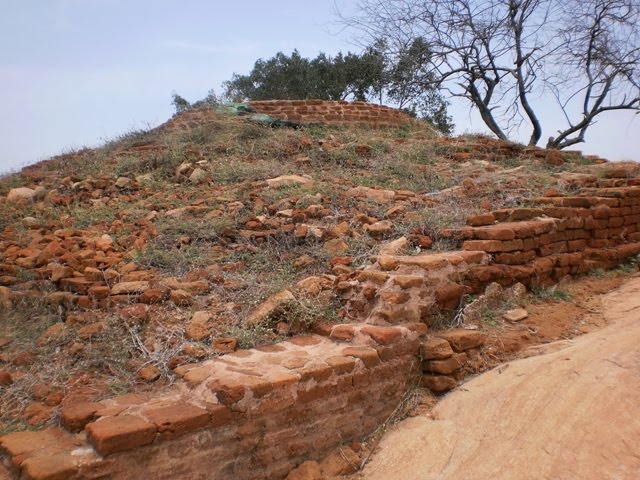


Pashana Pabbatha Viharaya in Punniyadi/Verugal (Kal-adi) which bears evidences of an existence of a flourishing Sinhalese Buddhist civilization in the area about two millennia ago is located 32 kms from the Seruvila Buddhist temple. The six inscriptions found in the temple with Brahami letters make references of a sophiscated civilization that flourished during the time with a network of banking systems and commercial cities.
The temple is located on a top of a rock with a commanding view of all the directions. Atop the rock one can see a fascinating view of sea on the Southerly direction and on other directions acres of paddy fields, scores of houses built by NGOs for tsunami victims and the thick jungle that stretches for miles.
This important Buddhist temple has born a great deal of damage as a LTTE's Voice of Tigers communication tower had been built there destroying the Stupa of the temple. The old bricks of the Stupa can be found strewn all over the place. What is left with the remnant of the building is not 03 feet in height. The diameter of the ruined Stupa is about 50 feet at its base and its domed body has extensively been dug. The portion of it has been destroyed giving way to build the communication tower. It can be observed that several types of bricks had been used for building the Stupa. Curved shaped bricks strewn around the area suggest that they were part of spire of the Stupa. The types of bricks suggest that the building had been built at the begging of the 1st century. A base stone of a pillar found among the bricks and a line of holes grilled on the rock suggest that there had been another building below the stupa. A flight steps carved in the rock suggest that the entrance to the top of it was located facing the south. The north side of the temple is a precipice.
The six inscriptions on the rock are among the most important archeological ruins found in the place. Three of them, located close to each other, are on the western side of the rock on which the Stupa is located. Due to continuous treading on them the script of them has started to erase. The forth inscription is on a rock below with much worn out condition. The fifth and the sixth are on the rock behind.
The first inscription among the first three is relatively clear though some letters are worn out. It starts with words 'Amathe rakayame pahana pavatha vihara' and it goes on to refer about an offering of gold coins. According to one of the inscriptions this Buddhist temple/monastery has been built by king Mahadatika Mahanaga.( 9th to 21st BC). Number of inscriptions with this king's name has been found in several places in the Eastern areas of the country located close to sea. The most striking feature of the script written in the inscriptions in Pasana Pabbata Vihara is that the king is referred as Mahadatiyanaka maharaja while in the inscriptions found close to sea he is referred as 'Naka Maharaja'. This is very clear evidence that this temple is dated older than 2000 years.
As per the inscription the king has made the temple the beneficiary of water tenure from a nearby stream. The king has also made temple's lands exempted from the land tenure which had been imposed on the people in the area. An accompanying small inscription of the first inscription says that the king Mahadatika Mahanaga has bought a land and offered to the Pasana Pabbbatha temple.
The second inscription goes on to say that a minister named Rakhaya has offered the interest he earned out of depositing five hundred gold coins in a bank. This bank is appeared to have been linked with a commercial establishment. In Sri Lanka's historical records, foremost among the inscriptions which bear the reference about bank systems is the Thonigala inscription found written during the King Kithsirimevan (299-327). However, the Punniyadi inscriptions are older dated.
The third inscription mentions about a commercial city named 'Thadavita'. It had a commercial centre named Manarama. It goes on to say that the King Mahasen(276-299) has offered what he earned from the interest depositing paddy from his own fields in a bank.
Another inscription says that what was earned from the interest depositing something (It is not exactly clear what was deposited) in a bank in a commercial city named Thubavatiya located east of the city was offered to the Mangala Chaittya(Mangala Stupa). So it is clear that the Stupa now in ruins in Pasana Pabbatha Viharaya in Punniyadi was referred as Mangala Maha Chaittya.
The other inscription contains references that gold coins were offered to the temple for meeting the expenses for alms for resident Buddhist monks. As per these inscriptions it is clear that there had been major commercial cities in Seruvila area with a flouring bank system. It has been proved that all the names mentioned in the inscriptions are Sinhalese.
By judging all the details it can be summed up that the Pashana Pabbatha Viharaya built in early centuries has evolved into a magnificent rock temple with many Buddhist monks in residence. Archeologists are yet to read all the inscriptions which will give us more details about this magnificent temple.
However, it is pity to see the effort taken by the Eelamists , deceived by a bogus history, to eliminate the evidences of the Sinhalese Buddhist civilization that exited in the North and East of Sri Lanka. Pashana Pabbatha Viharaya is just one example of thousands of such places in the North and East that could not escape the wrath of Eelamists.
Source: Pacheena Passa- Uttara Passa-Nagenahira ha Uturu Palathe Sinhala Bauddha Urumaya by Venrable Ellavala Medhananda Thero.
Subscribe to:
Posts (Atom)