Wednesday, July 28, 2010

“All Tamilians in Sri Lanka are happy with the government as it treats everyone equal”- Asin Thottumkal

 A good slap on the faces of Tamil Nadu racists!
Asin braved many threats from the so called "Tamil Nadu actors" even with her home being laid siege. But she was undeterred and displayed a remarkable solidarity with Sri Lankans.
 Though she is non-Sri Lankan I would say she is more "patriotic" than most of our own hypocritical cowards.     
The so called "International community" and other opportunists who shout from roof tops that Tamils are discriminated in Sri Lanka have even never dared to visit Sri Lanka and see in their own eyes how Tamils are treated over here. Asin has witnessed it in her own eyes and seen the reality.
Most of the security related grievances that the Tamils had to face due to the war are no longer in existence. As discussed in one of my previous posts other so called "grievances" of  Tamils have been addressed by the successive Sri Lankan governments with Tamils enjoying as equal rights as other communities in Sri Lanka.   
It is the poor victims disillusioned by the bogus Tamil history in Sri Lanka or the 'Tamil Homeland' fantasy who are in the forefront spreading the monumental lies about Sri Lanka.   

Thursday, July 22, 2010

The cat is out of the bag! Navanethem Pillay is to do the final touches to Ban Ki- moon’s grand design against Sri Lanka!

Today's The Island's editorial tells the story in style. The cat is out of the bag! Ban Ki- moon has revealed that the expert panel appointed to 'investigate the "war crimes" allegedly committed by the SL security forces at the final stages of the war' is under Navanethem Pillay's Office. One should not be a rocket scientist to fathom what Moon is up to. 
·      Navnthan Pillai has been a staunchest opponent of Sri Lanka harboring a strong hatred against her present government that defeated the terrorism and fascism. She did her best from Geneva to save the Prabhakaran and his cohorts at the final stages of war.  She has virtually become the mouthpiece of the anti Sri Lankan-Tamil Diaspora. Her outbursts against Sri Lanka are well known. So expecting a fair judgment for Sri Lanka from any committee or panel even having a distanced connection with her is a mere day dream, leave along if it is under her.

·      The other panel members' anti Sri Lankan stance is well known. Their track record with regard to Sri Lanka is well described by the Island's editor as follows.

(1)    Marzuki Darusman: Marzuki Darusman was part of the International Independent Group of Eminent Persons (IIGEP) involved in a presidential commission that probed some alleged violations of human rights in Sri Lanka. These eminent persons had a row with the government and left in a huff. Darusman is, therefore, prejudiced against this country.

(2)    Steven R. Ratner: Steven R. Ratner is of a similar mindset. He, in a book co-authored with Jason S. Abrams, Accountability for Human rights: Atrocities in International Law-Beyond the Nuremberg Legacy, advocates that the ban on apartheid be invoked in relation to some countries including Sri Lanka, which he refers to by innuendo.

(3)    Yasmin Sooka: Yasmin Sooka, a former Truth Commission member, is the executive director of the Foundation for Human Rights (FHR) in South Africa. Her outfit is heavily dependent on EU funds for survival. The EU has allocated a whopping 25 million Euros for one of its programmes. She is, therefore, beholden to the EU, which is leading a war crimes campaign against Sri Lanka from the front.

And also

(4)    Richard Bennett, the person who has been handpicked as the head of the staff of the expert panel is a trusted lieutenant of Pillay. He had been the Representative of the High Commissioner for Human Rights in Nepal until his latest appointment
 
·    So it is very much clear that 'appointment of the panel' is just a Trojan horse to give a legal status to a 'report' which will come out soon. The 'report' has apparently been already prepared with the support of anti-Sri Lankan forces: LTTE supportive Western nations and Anti-Sri Lanka Tamil Diaspora etc.
The most ridiculous part of the whole story has been that not only this grand plot against Sri Lanka's main architect's impartiality which is before a big question mark but also his integrity too as was widely reported in the media yesterday.

Sunday, July 18, 2010

Pashana Pabbatha Viharaya in Punniyadi in Trincomalee (3rd to 4th centuries AD), a magnificent Buddhist rock temple that existed 2000 years ago!

Pashana Pabbatha Viharaya in Punniyadi/Verugal (Kal-adi) which bears evidences of an existence of a flourishing Sinhalese Buddhist civilization in the area about two millennia ago is located 32 kms from the Seruvila Buddhist temple. The six inscriptions found in the temple with Brahami letters make references of a sophiscated civilization that flourished during the time with a network of banking systems and commercial cities. 

The temple is located on a top of a rock with a commanding view of all the directions. Atop the rock one can see a fascinating view of sea on the Southerly direction and on other directions acres of paddy fields, scores of houses built by NGOs for tsunami victims and the thick jungle that stretches for miles.

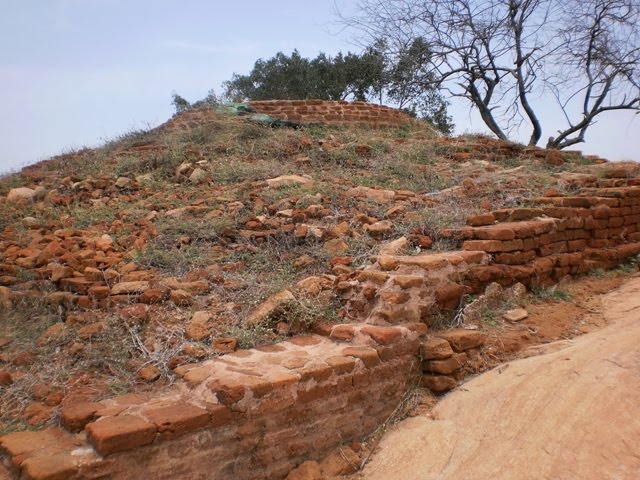
This important Buddhist temple has born a great deal of damage as a LTTE's Voice of Tigers communication tower had been built there destroying the Stupa of the temple. The old bricks of the Stupa can be found strewn all over the place. What is left with the remnant of the building is not 03 feet in height. The diameter of the ruined Stupa is about 50 feet at its base and its domed body has extensively been dug. The portion of it has been destroyed giving way to build the communication tower. It can be observed that several types of bricks had been used for building the Stupa. Curved shaped bricks strewn around the area suggest that they were part of spire of the Stupa. The types of bricks suggest that the building had been built at the begging of the 1st century. A base stone of a pillar found among the bricks and a line of holes grilled on the rock suggest that there had been another building below the stupa.  A flight steps carved in the rock suggest that the entrance to the top of it was located facing the south. The north side of the temple is a precipice.            

The six inscriptions on the rock are among the most important archeological ruins found in the place. Three of them, located close to each other, are on the western side of the rock on which the Stupa is located. Due to continuous treading on them the script of them has started to erase. The forth inscription is on a rock below with much worn out condition. The fifth and the sixth are on the rock behind.

The first inscription among the first three is relatively clear though some letters are worn out. It starts with words 'Amathe rakayame pahana pavatha vihara' and it goes on to refer about an offering of gold coins. According to one of the inscriptions this Buddhist temple/monastery has been built by king Mahadatika Mahanaga.( 9th to 21st BC). Number of inscriptions with this king's name has been found in several places in the Eastern areas of the country located close to sea. The most striking feature of the script written in the inscriptions in Pasana Pabbata Vihara is that the king is referred as Mahadatiyanaka maharaja while in the inscriptions found close to sea he is referred as 'Naka Maharaja'. This is very clear evidence that this temple is dated older than 2000 years. 

As per the inscription the king has made the temple the beneficiary of water tenure from a nearby stream. The king has also made temple's lands exempted from the land tenure which had been imposed on the people in the area. An accompanying small inscription of the first inscription says that the king Mahadatika Mahanaga has bought a land and offered to the Pasana Pabbbatha temple.

The second inscription goes on to say that a minister named Rakhaya has offered the interest he earned out of depositing five hundred gold coins in a bank. This bank is appeared to have been linked with a commercial establishment. In Sri Lanka's historical records, foremost among the inscriptions which bear the reference about bank systems is the Thonigala inscription found written during the King Kithsirimevan (299-327). However, the Punniyadi inscriptions are older dated.

The third inscription mentions about a commercial city named 'Thadavita'. It had a commercial centre named Manarama. It goes on to say that the King Mahasen(276-299) has offered what he earned from the interest depositing paddy from his own fields in a bank. 

Another inscription says that what was earned from the interest depositing something (It is not exactly clear what was deposited) in a bank in a commercial city named Thubavatiya located east of the city was offered to the Mangala Chaittya(Mangala Stupa). So it is clear that the Stupa now in ruins in Pasana Pabbatha Viharaya in Punniyadi was referred as Mangala  Maha Chaittya.  

The other inscription contains references that gold coins were offered to the temple for meeting the expenses for alms for resident Buddhist monks. As per these inscriptions it is clear that there had been major commercial cities in Seruvila area with a flouring bank system. It has been proved that all the names mentioned in the inscriptions are Sinhalese.   

By judging all the details it can be summed up that the Pashana Pabbatha Viharaya built in early centuries has evolved into a magnificent rock temple with many Buddhist monks in residence.  Archeologists are yet to read all the inscriptions which will give us more details about this magnificent temple.

However, it is pity to see the effort taken by the Eelamists , deceived by a bogus history, to eliminate the evidences of the Sinhalese Buddhist civilization that exited in the North and East of Sri Lanka.  Pashana Pabbatha Viharaya is just one example of thousands of such places in the North and East that could not escape the wrath of Eelamists.                                 
 Source: Pacheena Passa- Uttara Passa-Nagenahira ha Uturu Palathe Sinhala Bauddha Urumaya by Venrable Ellavala Medhananda Thero.  

Wednesday, July 14, 2010

The latest Cabinet meeting held in Giranike (Killinochchi)!

How ironical! The so called 'Political Headquarters' of the 'Thamil Eelam' has turned into the venue of  the latest cabinet meeting of the Democratic Socialist Republic of Sri Lanka. Almost one year back mere mentioning of such an event was a laughable day dream for many. The very same place was once boasted to have been the abode of the office of the "Political Head of the Thamil Eelam" who once boasted that he will turn Sri Lanka's capital into living inferno.  
I feel this is an apt occasion to throw some light how the place name Kilinochchi was coined from the original Sinhala name.  As has been the case with many places in North and East of Sri Lanka, the original Sinhala name Giranike has been Tamilinized as Kilinochchi.  The following quoted piece of description in an advertisement by the Commercial Bank in a national news paper of its opening of a new branch in the last month there says it in style.      
"The parrots (Gira in Sinhala) who came in flocks perched on the Nika Trees (Vitex negundo) that grew in abundance there and it was why the place was named "Giranike".
In Tamil parrot is called "Killi" and the Nika tree is known as "Nochchi". Through the combination of these two words, the name Killi-nochchi was coined".
Archeological evidences including stone inscriptions once strewn in the area and now destroyed as well as the descriptions in chronicles including Mahavamsa and Deepavamsa say that this area was once a vast complex Budhdhist monastery in which thousands of Arhats were residing.      
 The Eelam Day Dreamers fantasized by a Bogus Tamil history in Sri Lanka had been under the illusion of having this place to be the "Political Head Quarters" of the future 'Thamil Eelam'. It was a common scene a couple of years back that hordes of Eelam supportive Western lackeys were going in procession to this place to worship the 'Leaders of the Eelam government'. Unable to bear the  catastrophic proportion of turn of events,  Eelam supportive Western lackeys now have resorted to arm twisting of Sri Lanka with economic embargoes and appointing 'Advisory Committees' to 'investigate' the so called 'war crimes' allegedly committed by the Sri Lankan armed forces.  
However, It is heartening to see how the people there who had for long been at the gun point of the so called freedom fighters now enjoy the real freedom with the dawn of peace thanks to the enormous sacrifices made by our valiant security forces.

Saturday, June 26, 2010

Unarmed terrorists in Sri Lanka

The latest post by Peramune Rala titled 'Population jihad, case study from Eastern province' prompted me to write this post. His posts have been real eye openers with ground breaking revelations. His latest post discusses a very important issue which will create an unimaginable scale danger to the country in the near future-the huge population growth of Muslims. As has been highlighted by many concerned observers with raised eye brows, in few years time there will be many adverse outcomes of this phenomenon.  Though this is common to other part of the country too it is quite apparent in the Eastern province. (And this has not confined to Sri Lanka along too)
One of the quite visible outcomes of this has come to the public limelight in the form of mass scale land grabbing happening in the Eastern Province. A few examples will suffice to realize the great danger that lay ahead.  This uncontrolled population explosion has led to the encroachment and grabbing of lands belonging to the State and lands belonging to other communities leading tensions among the them.  These lands include lands belonging to the department of forest and department of archeology etc. And also lands belonging to Sinhalese and Tamils are encroached or grabbed in an unprecedented scale. The brunt of the damage is born by the poor Sinhalese as they are the minority in the province especially in the Ampara District. Incidentally, they have become unfortunate victims of discriminations by the racist Tamil and Muslim government servants in the districts.  Most of the cases poor Sinhalese are intimidated with death threats and are driven from their ancestral lands. This is the same case of the many Buddhists archeological sites and temples. Those lands are grabbed with the politicians' support. This happened in a greater scale when the Muslim fundamentalist Minister Ashrof was in power. The best case in point, as known to many, is Deegvapi. What happened in Deegvapi is history now. But what is unknown to many is the fact that the land grab which became the limelight of attention to many on those days goes on in the same scale as before. The vast numbers of acres of land in Degavapi has been grabbed now.  But the department of archeology is in deep slumber, perhaps due to a couple of reasons: The political support behind this land grab is so strong that the officials at the department are in a helpless situation or the officials at the   Archeological department are being bribed not to take any actions or the intrusion of Muslim officials into the department of the archeology in the Ampara district.
 A few more examples will suffice to realize the great danger that lay ahead.  A few years ago Vanagamua was flourishing Sinhala village in the Akkaraipattu DS division in Ampara District.(this village is a Purana Village ).But now the village name has changed into " Vankamam", a highly populated Muslim village with few mosques. This happened in less than 05 years time.  This is the fate of many other Sinhala villages in the Eastern province. The population growth among the Muslims is such that many acres of lands belonging to the department of forest have been grabbed resulting in mass scale deforestation in Kuchchaveli (Kusalaveliya) in Trincomalee. Just before the war started Kuchchavlei was a small fishing village with a few mud thatched houses. At present Kuchcaveli is a highly populated Muslim area with many thousands families. And also   Kanthankudi in the Batticaloa district was reported to have been the area with the highest population density in the whole South Asia. This was reported about two decades ago.
This intentional population growth by Muslims aimed at becoming the Majority community in Sri Lanka is surely setting the stage for the next terrorists' war though it is unarmed for the moment.

Tuesday, June 8, 2010

Mrs. Amirthalingam’ s expression of gratitude to the Police officer who killed her beloved husband’s assailants: a story of bizarre irony of fate of Eelam proponents

Media reported recently that the wife of late Amirthalingam had expressed her gratitude to the police constable who shot dead the three assailants of her husband killed 21 years ago. It is a bizarre irony of fate that a wife of a staunchest proponents of Eelam expressed her gratitude to a person belonging to the community who Eelamist's consider as their arch 'enemies'-the Sinhalese. Above all, he was from the Sri Lanka police whom Eelamist refer as the 'occupational Sinhala army or police who are hell bent to kill Tamils'.    
Amirthalingam's wife was also an ardent supporter of the Eelam dream. She was once heard declaring in a public meeting held in Jaffna in late 70s that the Sinhalese should be skinned to death and then their skin should be used to make shoes.  What a bizarre turn of events! For Amirthalingams the LTTE terrorists were "our boys". 
The Sinhalese police officer displayed this daring act knowing very well that his life was at a great risk. The assailants and the target are both consider the latter's protector as a one from their arch 'enemies', the Sinhala community. The Sinhalese policeman could have easily fled from the scene leaving the two parties to settle their scores having known very well that both the assailants and their target were perusing a same goal-achieving the Eelam.         
Mrs. Amirthalingam came to Sri Lanka in a gap of 21 years and made a visit to the house of the Sinhalese policeman/bodyguard who shot dead the three LTTE terrorists who killed her husband. Her son had also accompanied her to the policeman's house in Kegalle and both the mother and the son had reportedly broken in tears while embracing him as if they saw their own affectionate son/brother after a long period of time. Mrs. Amirthalingam had reportedly thanked President Rajapaksha for elimination the LTTE. The LTTE monster created by Amirthalingams turned towards them and eliminated most of its creators along with thousands of Tamils of whom they claim to have been the sole representatives. It is the same Sinhalese 'enemies' who saved them and paved the way for their creators to return to their motherland without fear of blown by human bombs!     
Sri Lanka's armed forced displayed the similar type of courageous and humanitarian acts on numerous occasions sacrificing their own lives and limbs, the latest being the world's largest rescue operation when they rescued the thousands of Tamil civilians at the last stages of war when the so called 'guardians' and the 'protectors' of the Tamils used them as a protective shield risking their lives. The history of the conflict is replete with similar daring and humanitarian acts on the part of our security forces but they are swept under the carpet by the Eelamists in order to furtherance their Eelam dream.  

Sunday, May 16, 2010

ILAM (Eelam) = Sinhala Homeland !

This article appearing in today's The Nation paper throws more light to expose the 'Tamils Homeland' fantasy with a fine analysis of the Tamil lexicon meaning of the word Eelam itself which means the Sinhala Land. Lt Col. (Retd) Anil Amarasekera, a prolific writer and a scholar finely analyses some critical reasons behind the defeat of the LTTE in his latest article. The first reason he highlights is based on the fact that 'false claims cannot and will not succeed'. Therefore, the defeat of the LTTE is simply a story of the Truth's triumph over the falsehood.
I quote the relevant paragraph of his article which brilliantly exposes the fact that the word Eelam means none other than the Sinhala Land        
"With regard to territorial claims made by the LTTE the word ILAM (Eelam), comes into much prominence. It is, apparently, being used to connote the impression of "a land of the Tamils". Indeed, the Tamil word ILAM was never before used in that sense. On the contrary, this Tamil word ILAM did not refer to Tamil land but to the "Land of the Sinhala people". None other establishes this than the Tamil lexicon published under the authority of the highest seat of Tamil learning - the University of Madras. Page 328 of this Tamil lexicon has the following entry: ILAM, n< Pali, Sinhala, 1. Ceylon. What it says is that ILAM means the land of the Sinhala people. The Tamil word given as the meaning of ILAM reads "SINHALUM". The term ILA in Tamil means "SINHALA", having its origin in the word HELA, by which term the ancient people of LANKA were known. Thus ILAKKACHU in Tamil means "Sinhala Coins"- ILA means Sinhala, Kachchu means Coins. Similarly, since NADU means LAND, ILANADU means the Sinhala land. According to the said lexicon the word ILANADU was derived from ILAM. The foregoing establishes the fact that the word ILAM (Eelam) never referred to any Tamil land but always signified the Sinhala land. Therefore, if one were to ask for ILAM (Eelam), what is being asked for is the traditional homeland of the Sinhala people. Therefore, such false claims cannot and will not succeed and that perhaps is one reason for the defeat of the LTTE."
So the time is ripe for those who are in search of a homeland for Tamils to change its name first foremost and then start the search to locate where it truly exists. But it is certainly not in Sri Lanka!